OK, you have new binoculars and field guides and apps, you’re watching the common birds at your feeders, but now you want to see more. Perhaps you tried going out to your local park, but either you don’t see much, or you get frustrated because you don’t know what you’re looking at. What do you do next?
Go out with birding groups. Is it better to go out birding alone or with a group? The answer is that there are advantages to birding alone (or with a friend) and advantages to birding with a group. When birding alone you can move at your own pace, go wherever you want, and spend as much time observing any single bird as you like. All of these are great. But also realize that birding with a group has several advantages, especially if you are not very experienced. First, the local birding groups will be visiting the locations that will be most productive at that time of year, and taking a route that will optimize finding birds in that location. This is especially valuable when birding larger parks or locales. It is worth joining with these groups to learn the ‘standard’ routes, which you can then explore on your own later. Second, the group leaders will have historical knowledge of those locations. It is very beneficial to know that a specific part of a park or a preserve might be a historical hotspot for an interesting species. You will learn things like ‘this field is normally very good for bluebirds’ or ‘we have found woodcock at this location for the past five years’ that would otherwise be difficult to learn by yourself. Third, when birding with a group there are many pairs of eyes looking for birds, so the group typically will find more birds than any single birder can. Fourth, beginners who go out with groups can learn good birding habits, by watching the leader or the experienced birders in the group. Watch what they do and what they don’t do, and then emulate those same good habits when you are birding by yourself. Note how quietly and slowly they proceed, how they are listening for bird sounds, and what types of hab itat they spend the most time in. These good habits are not easy to learn from books or field guides. Finally, by joining occasionally with groups you can meet other birders with similar levels of expertise that you might be comfortable birding with together later outside of the larger group. Any hobby becomes more enjoyable when you meet other people who have those same interests, making you feel like part of a greater whole. The only real disadvantage of group birding is that popular walks can become large, resulting in too much disruptive noise, but this negative aspect is balanced by the many advantages of joining a group. So in the end, my suggestion is to go out with birding groups (like SOBG) when you are starting your birding journey, and after you gain more expertise, then you can venture out alone or with a small group of two or three friends.
Keep records. Many birders keep lists; lists of life birds, lists of year birds, lists of county birds, lists of yard birds, and more. I once met a photographer who told me that he kept a list of how many bird species he photographed with that specific camera. I am not an advocate of extensive listing, because when taken to an extreme it can become almost pathological, to the point where adding a species to a list becomes more important than actually enjoying the bird itself. I will, however, advocate more general record keeping and describe its advantages. Keep track of the birds that you see and their relative abundance after returning from a field trip. Record keeping such as this will allow you to notice the ebb and flow of birds through your area; when do the shorebirds or warblers arrive in your area during spring, when do they leave during the fall, and do they arrive and leave all at once or do subsets arrive and leave before others? After keeping records such as this for a year or two you will then be able to anticipate the arrival of new species and their departure, thereby becoming familiar with the rhythms of the year. If you can equate bird arrivals and departures not just with the calendar year, but with other natural events such as the appearance of specific flowers or fruits or insects or butterflies, you will then be able to link bird movements in with the bigger picture of natural events.
So how should record keeping be done? One way is to use a typical old-school handwritten version with field notes and drawings. Th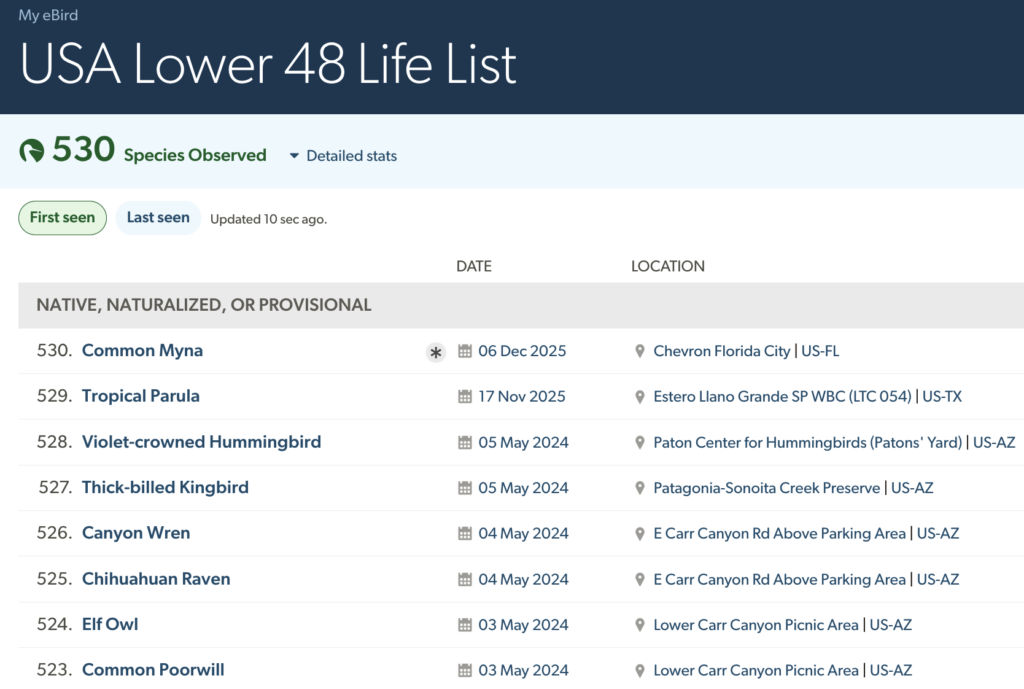 is approach has a romanticism about it, but lacks some of the benefits of electronic versions. The major advantage of electronic record-keeping is that it allows searches for specific birds or locations or dates that are not possible with pen-and-paper methods. For example, I often like to search through old records for a single species, such as when and where I saw Pileated Woodpecker. Or if I’m wondering when to put out the hummingbird feeders, I can search for their typical arrival dates each year. Or when did I observe the peak migration of Broad-winged Hawks at the hawk watch? Although record keeping can be done using any electronic database, most birders now use eBird (ebird.org). We will learn more about eBird in a later post, but for now we will simply note that eBird has the advantage of very easy data entry without extensive typing, the ability to include photos or comments, and the sightings become part of the larger eBird database, contributing to ‘citizen science’. As a side benefit, eBird will automatically generate updated life lists, year lists, state lists, etc. Regardless of whether you keep track of your sightings through eBird or a different electronic database, you will benefit from keeping records and the ability to search through your previous field sightings.