OK, you’ve decided that you’d like to try birding as a hobby. Maybe a friend or someone in your family is trying to get you interested. Perhaps you’ve just seen an interesting colorful bird and now want to find more. Maybe you are now retired and have time to pursue new interests. Regardless of how or why you begin with this hobby, birding can be overwhelming as a beginner and it can be intimidating to ask for help from some of the ‘experts’ who are around. If this sounds familiar, it is hoped the series of recommendations presented here can help you on your way. We’ll start this series with three tidbits of advice.
1. Hang in there. Probably the best place to start is by saying that if birding is difficult in the beginning, by all means don’t give up. Any pastime can be tough in the earliest learning stage. Birding is a great hobby that will provide rewards for years and years and years to come, so persistence gets rewarded. As your birding experience grows, the common birds eventually will become easy to identify, but then a new group of challenge s, including rarer birds, birds in different plumages, birds in different locations, and learning bird songs will continually arise and present new challenges and new opportunities to learn. Yes, it can be tough in the beginning when it feels like you don’t know anything, but turn the difficulties of this early stage into a positive. For example, it is tough for an experienced birder to find birds that they have never seen before, but novice birders can record a few new species in a single outing. Enjoy the thrill of learning during your earliest birding adventures.
2. Get decent optics. One of the advantages of birding is that it doesn’t have to be an expensive hobby. At a simple level, the essential equipment is a pair of binoculars and a field guide. That’s it. As your interest in the hobby grows, you might find yourself buying more equipment: a spotting scope, specialized identificati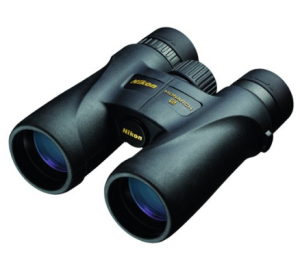 on guides, photographic equipment, birding apps, camera gear, etc. But don’t worry about them now, since they are non-essential. Let’s start at the beginning: what binoculars to get? I have seen far too many beginning birders fumbling with their outdated or unsuitable old hand-me-down binoculars and getting frustrated while others are seeing birds. Fortunately, excellent binoculars can be obtained for ~$300 that will last for many years. The most popular model in this price range seems to be the Nikon Monarch5 8×42 binoculars, but other binoculars in that range should be adequate. I used a pair of 8×42 Monarchs for more than 10 years and still have them as my backup pair. The optics are terrific, they are waterproof and fogproof, can focus to within 8 feet, and Nikon provides a lifetime warranty. After you’ve been birding for several years you might want to upgrade, but as a beginner, the Nikon Monarchs or similar quality binoculars is a great place to start. The only caveat to this recommendation is that no pair of binoculars will be perfect for every person; if you wear eyeglasses or if your eyes are closer together or further apart than most people, then test them yourself before buying to ensure that they ‘feel’ right to you. It is well worth the investment to avoid the frustration caused by poor optics. For more detailed information on choosing binoculars, a web page such as this will be helpful. Having good optics is the first step; once you have them, get used to them, by practicing focusing on things that are close, then far, then close, again, etc. When you can do that quickly, then you are ready for birds.
3. Birding books / apps. There is an entire industry of birding books out there, enough to keep even the most refined expert birders occupied. But which of those books is appropriate for a beginning birder? For 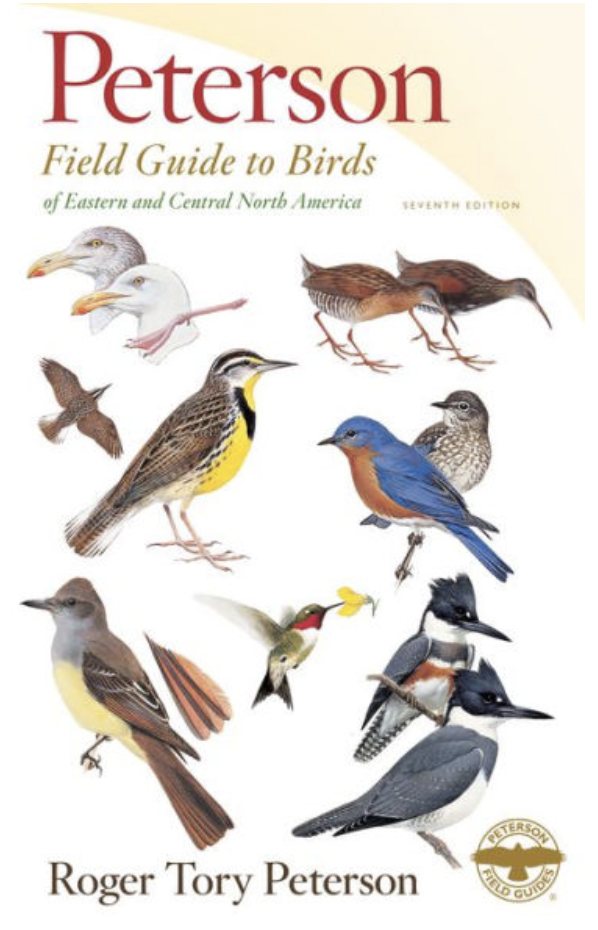 me the best field guide for a beginner is the Peterson Field Guide to the Birds of Eastern and Central North America (or Western North America if that is where you live). The Peterson’s Guide, which first was published in 1934 and is now in its 7th edition, was the first modern field guide for birders and to me still remains the best guide for beginners. It focuses on the more common birds, the illustrations are large, with arrows that point to the essential field marks that we should be looking for, and maps display the geographic distribution of each species. The Peterson’s Guide also comes in a large-format edition and they now offer a Peterson’s “First Guide” that includes only the 180 most common birds in North America, if those are your preferences. Another excellent option is the Sibley Field Guide to Birds of Eastern North America (or Western North America if that is where you live). To me, the Sibley Guide is actually a better field guide, but it is somewhat targeted for more advanced birders. Like the Peterson’s Guide, Sibley also has wonderful illustrations with arrows to point out the essential field marks. There are more illustrations in Sibley, including juvenile and female plumages, and birds in flight, but by necessity the illustrations are smaller than in Peterson. Sibley also includes more rarities that can appear in your area, but since those birds are unlikely to found by beginners, they can be a distraction. Maybe it is just a matter of taste; these are both excellent and influential field guides, but I think Peterson’s is better for beginners, while Sibley is better for advanced birders. Whichever book you buy, don’t leave it in your car or at home for future reference, but instead bring it with you into the field and use it thoroughly, on the spot. When you find a new bird and read the accompanying commentary immediately, you will learn more, because the guide will point out secondary identification points to look for that you might have missed, occasionally behaviors will be described, potentially confusing species might be mentioned, or the illustrations might help you to find females or immature birds in the area. If you only look that information up after you get home or to your car, it will be too late.
It is worth mentioning that both the Peterson’s and Sibley guides (and others) are available as phone apps. Having the apps has the advantage of not having to carry a book into the field, and also gives access to bird sounds that can’t be found in any book. Again, the choice of book or app is a matter of personal preference.